


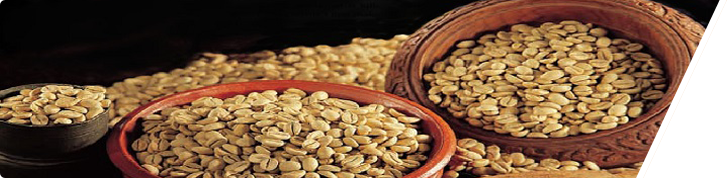
 The saga of Indian coffee began on a humble note, with planting of ‘Seven
seeds’ of ‘Mocha’ during 1600 AD by the legendary holy saint Baba Budan, in
the courtyard of his hermitage on ‘Baba Budan Giris’ in Karnataka. For quite
a considerable period, the plants remained as a garden curiosity and spread
slowly as back yard plantings.
The saga of Indian coffee began on a humble note, with planting of ‘Seven
seeds’ of ‘Mocha’ during 1600 AD by the legendary holy saint Baba Budan, in
the courtyard of his hermitage on ‘Baba Budan Giris’ in Karnataka. For quite
a considerable period, the plants remained as a garden curiosity and spread
slowly as back yard plantings.
It was during 18th century that the commercial plantations of coffee were started, thanks to the success of British entrepreneurs in conquering the hostile forest terrain in south India.
Since then, Indian coffee industry has made rapid strides and earned a
distinct identity in the coffee map of the world.
Coffee in India is grown under a canopy of thick natural shade in ecologically
sensitive regions of the Western and Eastern Ghats. This is one of the 25 biodiversity
hotspots of the world. Coffee contributes significantly to sustain the unique bio-
diversity of the region and is also responsible for the socio-economic development in
the remote, hilly areas.
In India, coffee is traditionally grown in the Western Ghats spread over
Karnataka, Kerala and Tamil Nadu. Coffee cultivation is also being expanding
rapidly in the nontraditional areas of Andhra Pradesh and Odisha as well as
in the North East states.
Coffee is predominantly an export oriented commodity and 65% to 70% of
coffee produced in the country is exported while the rest is consumed within
the country.
Indian coffee has created a niche for itself in the international market and the
Indian Coffees are earning high premium, particularly Indian Robusta which
is highly preferred for its good blending quality. Arabica Coffee from India is
also well received in the international market.
Coffee is an export product with low import intensity and high employment
content. This is evident from the fact that more than six lakh persons
are directly employed and an equal numbers of individuals get indirect
employment from this sector.
The two main varieties of coffee viz., Arabica and Robusta are grown in
India. Arabica is mild coffee, but the beans being more aromatic, it has
higher market value compared to Robusta beans. On the other hand
Robusta has more strength and is, therefore, used in making various
blends.
Arabica is grown in higher altitudes than Robusta. The cool and
equable temperature, ranging between 150C to 250C, is suitable for
Arabica while for Robusta, hot and humid climate with temperature
ranging from 200C to 300C is suitable.
Arabica requires more care & nurture and is more suitable for large
holdings whereas Robusta is suitable irrespective of size of the farm.
Arabica is susceptible to pests & diseases such as White Stem Borer,
leaf rust etc., and requires more shade than Robusta.
The harvest of Arabica takes place between November to January,
while for Robusta it is December to February.